


Welcome back to the Norfolk stone carving workshop, ‘Ar yer orrite buh?’
Here’s a brief look at what we have been up to over the past few months including stone carvings, workshop news, on-site work and road trips. Since my last post we have been up to all sorts, and I’ll try and give you a flavour of this……..

My last post featured some figurative sculptures that were based on ancient Italian ‘Steles‘ (click the link to discover more) from around 3000BC. I had a client and her sister visit me over the summer as they wanted to commission me to make a memorial for their parents. They were so taken by the Stele (which is really just a word for monolith) sculptures that they felt it would be the perfect way to remember their parents. Their mother was very spiritual and their father sculpted stone among other things. This led to creating this unique stone, which now resides in Woodbridge Cemetery in Suffolk.


Another of my passions, well it’s very linked to my love of ancient figurative carvings, is studying Neolithic carving. I had another open minded client recently who was inspired to commission an equally unique memorial for their parents in Grantchester, near Cambridge. We had a shared love of the carvings at Newgrange for example. The back of the stone is riven and natural, effectively the crust is still on the block, rather than it being sawn off at the quarry. It features some neolithic patterns carved as a response to the surface rather than imposed on it as a rigid design. The front is honed (a smooth rubbed surface). It’s a very textural piece, as indeed are the figures above. I love to explore texture in my work. There is a really nice stop-animation video of the making of this piece on my Instagram here. Do check it out if you like this piece as it shows the somewhat improvised, direct nature of the design of this. You’ll find lots of other images and videos on my Instagram too. The side of this stone had some lovely veining running through it.


These chunky memorials are heavy and I decided to make some improvements to the easels in the main carving room to help with both the material handling and the physicality of the carving process, and the importance of having the stone at a good height. One of my easels had a block and tackle attached to an RSJ that I installed when I first moved here (it was fun, lifting up the RSJ on my own as it is about 5m long). You can see it in these pictures:


This actually worked really well as a system, over the last 23 years it has been faultless, with the hook attached to a lifting eye in the central ‘carriage’ that slides up and down. The main issue with it was that it was really noisy (ear defender territory) and quite cumbersome. We have been discussing more user friendly options for a while now and I felt that it was finally time, and I had some energy to put towards this change. We have 5 easels – one mobile (which you’ll spot later on in this post being used in Norwich Cathedral) and four built in easels. Only one of these had lifting gear on it and the rest were basically frames that we lifted things onto with a combination of various pump up trolleys, platforms and brawn. I decided to rebuild another one of these easels so we now have two that have electric winches on them, with remote controls. I bought these second hand on facebook marketplace, one for £65 and the big one for £100. This is a life changer for us, just walk the stone on, press a button an up they go, and fast! We use brackets and/or straps to hold the stones safely in place

But not everything is carved in the workshop…..

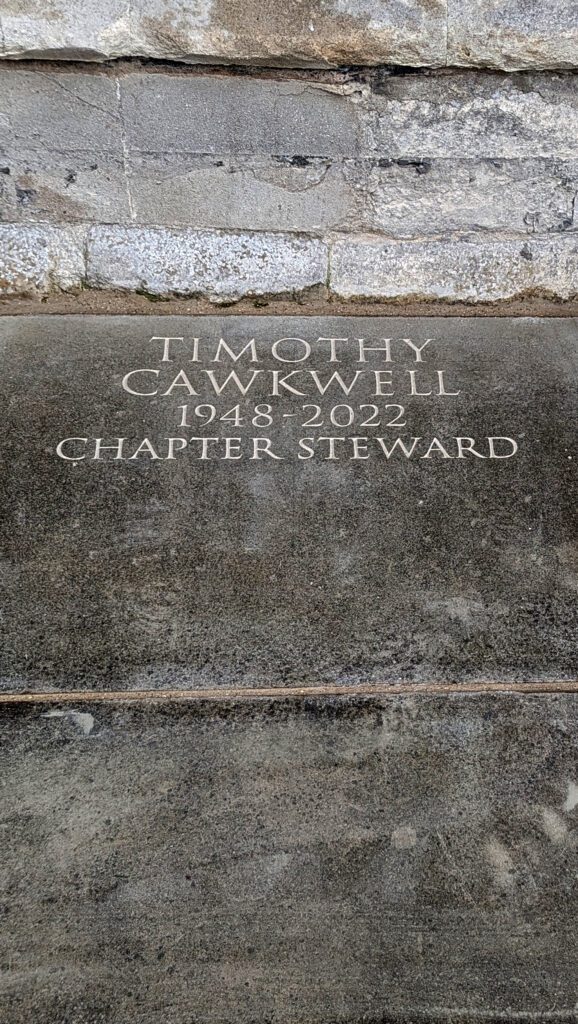
Last week I carved an inscription in the cloisters at Norwich Cathedral. The cathedral have a way of honouring certain people that have served the cathedral well over the years, and this involves carving their names into the fabric of the cloisters. Historically this has been done on the soft limestone of the walls (often quite badly!) and now more recently there is a preference for doing this in the weathered sandstone paving. I have carved lettering into both here in the past, and they each pose a different challenge. It has been suggested to me the limestone may be Ancaster stone, although it could perhaps also be Barnac or Clipsham or Ketton stone as opposed to the Caen stone of the main cathedral. It is a very rough oolitic stone, and looks like Ketton to me. Oolitic stone etymology: from the Greek ōión: egg/seed and lithos: stone (oo + lith). You can clearly see the structure of this stone if you zoom in using the camera on your phone, which I did when I was working on this, and it was scary to see what I was carving to be honest, or more to the point what I wasn’t carving! I carved the bottom three lines and take no responsibility for the rest of the letterforms on there!


The limestone above is very soft and crumbly, and as you can see the individual oolites are quite visible and can just drop out as you carve, so it’s really demanding work to get a good finish and the chisels need to be razor sharp. Carving the York stone inscriptions in the paving is a tricky operation in a different way. The first hurdle is cutting out the stone and lifting it without damaging it or the surrounding stones (I can’t carve these lying on my belly, that would just be odd). This removal is not straight forward, and on one occasion I found that cement based concrete had been used to stick a stone down and not lime mortar, which meant another two hours trying to free the stone. Once the stone is out I then lift it onto my mobile easel and carve it in situ. These slabs are heavy at nearly 3′ x 2′ and around 60mm thick. The carving process is definitely easier than the limestone, although as the stone is weathered and covered in slime and lichen the top 0.5mm is quite crumbly and sticky and that makes carving the thin serifs a bit tricky. Sandstone blunts the chisels more than limestone though, which is why it’s historically used to sharpen chisels. This commission took me about two days all in, with removal, drawing, carving and reinstalling. It was draughty and damp at times, and I resorted to the Bread Source Cafe when I was starting to go numb, which was a blessing. I like setting up my workshop here though, it’s a lovely place to be, but I felt I was being watched at times:




The change in the weather, and moving reluctantly from shorts and a vest to overalls, made me want to prepare the workshop a little more for the winter. Each year I do something to make my working life more pleasurable. This year it’s second hand doors and yet more draughtproofing. I managed to pick up two sets of used double glazed patio doors and fitted them myself with improvised studwork to fit the openings into the carving room and my gallery/office space. It’s going to be my first winter since moving my office into there, and it’s already quite cold, we have a woodburner in the carving room so that’s quite cosy. So, I invested time and money into removing the plywood barn doors I made about 20 years ago, and now we have warmer brighter rooms. It has made a lovely difference and although we still have cold floors and walls to some extent, at least the wind and rain don’t rush in under the doors any more. Before and after:


So, bring on the winter. The logs are stacked and most of the outside stays outside now.
I was recently working up near Liverpool, as I was installing a memorial in Dalton church near ‘Skem’, where I had worked previously. It was a chance to see some headstones I made in the past and check how they are weathering, and also to catch up with a large feature wall I designed in 2013.


The wall is Woodkirk stone, a sandstone from Yorkshire. The purpose of this wall was to create a feature wall that could house future inscriptions for the cremated remains section of the graveyard. Ashes would be buried using a grid system to locate them in the grass and there would be no clutter on the ground. I designed the wall to have two panels of lettering that would accommodate names for hundreds of years, and you can see above that we carved a few names in there ourselves. Here are a few more images of the wall as it was when new:


Unfortunately, someone had the depressing idea of placing horrific black granite plaques over the hand cut lettering as a way to update the inscriptions. I mean, honestly……..

I understand that it was easier, but it’s just so badly done. Why not at least use a stone that is more in harmony with the colour of the York stone, the mind boggles. Obviously I, the designer, wasn’t consulted.
Anyway I tried not to focus on this too much, as I was there to install a memorial round the back of the church. It’s my third memorial there actually, the first was a Welsh slate monolith, then I was asked to design the wall (a complete coincidence I might add, and I’m based over 250 miles away) and subsequently I have been asked to make another two stones. This is the first stone I installed there, for a lute player, and the Islamic pattern is based on the lute ‘rose’ on the soundboard of his own instrument.


The second stone is a large piece of York stone, chosen by the family as Martin was a very keen rock climber. The raised lettering on the front is really effective and the family were keen to let the stone weather naturally, and I think this is really only going to improve with age:


This shows the proximity of the three stones I have in Dalton

The latest addition to Dalton is Hopton Wood limestone from Derbyshire, which is very difficult to find these days. It’s a hard limestone, much harden than Portland stone, and more akin to Nabresina/Auresina/Roman stone or Moleanos for example. It holds a good edge and is much denser, and therefore it’s good for detail and crisp lettering. We decided it would be more subtle to leave the lettering unpainted as the stone is quite busy, with very intricate and abundant foliage and flower details (Rosa Glauca) and there is also lettering on front, back and sides. This means that even on a dull day, there will be lots of interest as you walk around the stone and depending on where the sun is different parts of the stone will come to life at different times. Here are a few pictures, some taken in the workshop and some on site:


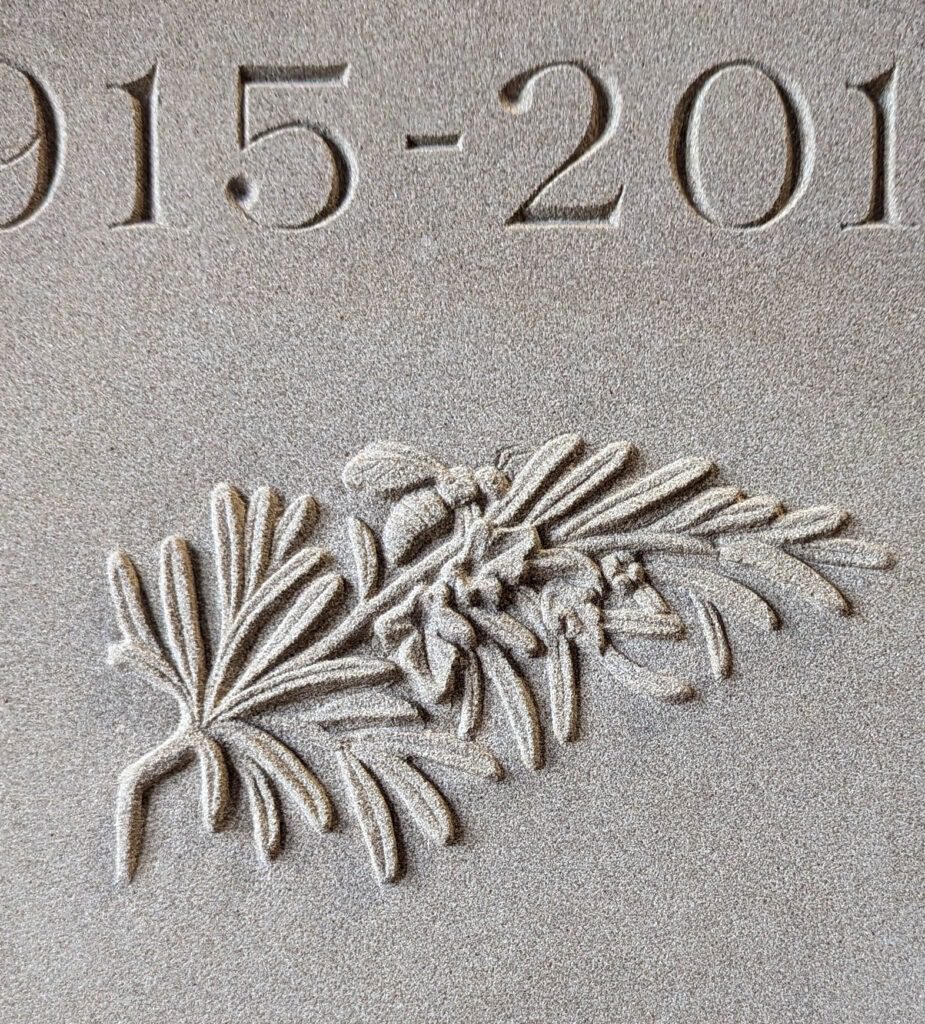
I’ll end this post with a few random images of other one off commissions we have worked on in the last few months a slate cremation plaque to a Scot, an addition to a Welsh slate memorial, a limestone memorial for the writer Ronald Blythe, a Purbeck ‘Pond Free’ limestone plaque for Eton college and a York stone memorial for a local agrarian, featuring wheat and rosemary and a wee bee;



Well done for getting to the bottom of my rambling blog. I try to be concise but as I don’t write a post very often there is often a lot to talk about.
until next time ‘Keep yew a troshin’ a Norfolk farewell


I saw your work at Chelsea and the Maccarthy headstone. I have such respect – beautiful.
thanks Duncan that’s kind. I think we are connected on instagram too now! If you ever need any carved stone features for your landscape work, let me know. I have quite a collection of beautiful monoliths in the yard…..
wonderful